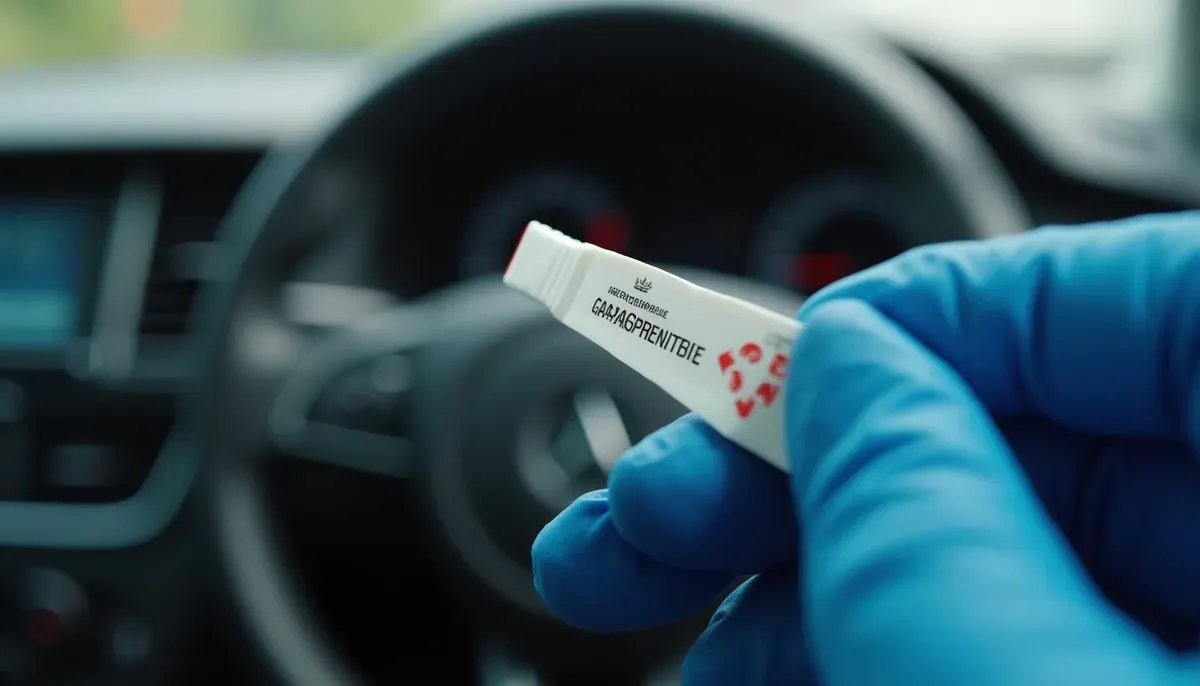
Saliva testing has become in 2026 the preferred drug screening method at the wheel in France. Over 800,000 tests are performed each year according to Ministry of Interior figures, of which about 5% prove positive. This procedure, framed by articles R235-3 and following of the Road Code, includes several steps: saliva screening test, confirmatory blood draw, and analysis at approved laboratory. Here is the full procedure and driver rights.
When is screening performed
Screening is mandatory in 4 cases: bodily or fatal accident (the involved driver is systematically tested), serious traffic offence (speeding over 40 km/h, priority refusal, dangerous driving), material accident at officer's discretion, and reasonable suspicion of consumption. In random control (no prior offence), the test remains possible but requires a public prosecutor requisition.
Random controls framework
Since the decree of March 2017, random drug controls are authorised on requisition. These operations focus on Friday and Saturday evenings, near nightclub exits, festivals, and sports events. 2025 statistics show 12% positive rate during these controls, more than double the average rate.
Saliva test procedure
The saliva test uses a DrugWipe or Drugtest 5000 type device. The officer introduces a swab in the driver's mouth for 60 seconds to collect saliva. The result appears in 3 to 8 minutes depending on the model. The device simultaneously detects 5 to 7 substances: THC (cannabis), cocaine, opioids, amphetamines, MDMA, sometimes benzodiazepines and methadone.
Saliva test sensitivity
The saliva test detects drug presence but does not quantify. Its sensitivity varies: THC detectable up to 6-12 hours after occasional use, 24-48 hours after chronic use, sometimes more in heavy users. Cocaine: 24 to 48 hours. Amphetamines: 24 to 72 hours. The test can give a false positive (very rare) or false negative (more frequent in case of very recent consumption not yet absorbed).
Confirmatory blood draw
If saliva test is positive, blood draw is performed within 4 hours at hospital or by approved physician. Blood is conditioned in two vials: one for immediate analysis by approved laboratory, the other for possible counter-expertise. The quantitative result (in ng/mL) confirms or invalidates the saliva test and is authoritative before court.
Legal threshold
The legal detection threshold for blood THC is 1 ng/mL since 2007 (decree of 13 December). Beyond, the driver is in offence. For cocaine, the threshold is 50 ng/mL for cocaine itself and 50 ng/mL for benzoylecgonine (metabolite). For amphetamines, 50 ng/mL as well. Any strictly higher result entails offence.
Detection delays by substance
Cannabis: 3 to 7 days in occasional consumption, 30 to 60 days in chronic consumption (THC stores in fats). Cocaine: 1 to 4 days, up to 14 days in chronic consumption. Amphetamines: 1 to 4 days. Opioids (heroin, morphine): 1 to 3 days. MDMA: 1 to 3 days. These delays explain why festive consumption Saturday night remains detectable behind the wheel the following Tuesday.
Contestation and counter-expertise
The driver has 5 days after result notification to request a blood counter-expertise, at their expense (200 to 400 euros). The second vial is analysed by another approved laboratory. In case of divergence, the result most favourable to the accused prevails. Admissible grounds: non-compliant collection conditions, deficient blood storage, non-approved laboratory. Full file consultation is of right via Mes Points Permis or directly via the prefecture.
Driver rights
The driver has the right: to know detailed results, to request counter-expertise, to be assisted by a lawyer from custody (often decided for serious positive controls), to prove a medical cause (prescribed painkillers may interfere with detectable opiates). Validly prescribed medication can justify a positive test for opioids or benzodiazepines. Presenting the prescription does not exempt from the test but will be taken into account by the court.
Immediate consequences
Following a positive saliva test, the officer retains the licence (72-hour retention, 138 D form). The prefect then issues an administrative suspension decision (up to 6 months pending judgment). The vehicle can be immobilised. The driver is summoned before the criminal court within 1 to 6 months depending on jurisdiction. Custody (24h renewable once) is frequent for serious cases or known repeat offenders.
Next step
How to get the right support?
DevisPermis.fr connects you for free with a certified driving school near you. Answer 5 questions in 2 minutes, and an advisor will call you back within 48h* to offer a tailored package.
Discuss it for free*Excluding Sundays and public holidays