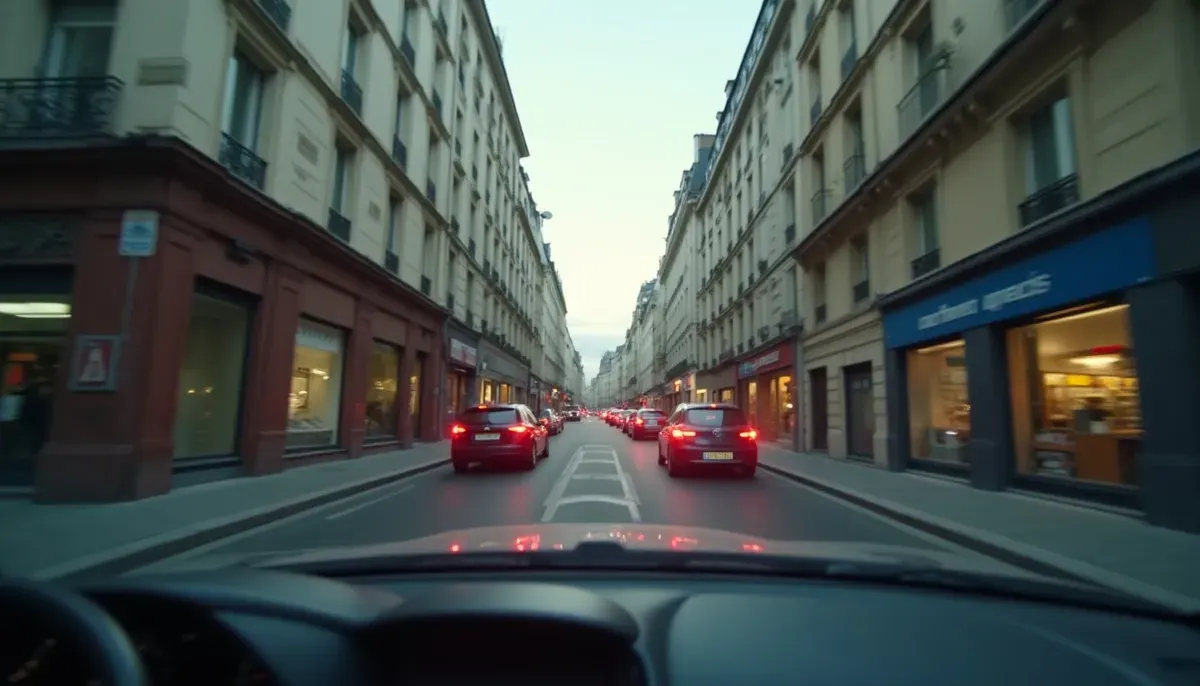
Priority to the right remains France's default rule per article R415-5 of the Highway Code, but it is especially tricky in Paris. In older districts (Marais, Montmartre, Latin Quarter), hundreds of small intersections have no sign or marking: priority to the right applies automatically. Missing this rule causes accidents and eliminatory test faults. This article details priority to the right, its exceptions (yield, stop), 30 km/h zones, T-junctions and Parisian one-ways often misunderstood.
Default priority to the right
At intersections without visible signage (sign, ground marking, light), any vehicle coming from your right has priority. This rule applies even if the right street is smaller or seems minor. In Paris, many candidates fail here: they underestimate a narrow right street and proceed, refusing priority. This is an eliminatory fault (E). Simple visual rule: at every unmarked intersection, systematically slow and look right. If a car comes, you yield.
Unmarked Marais zones
The 3rd and 4th arrondissements (Marais) hold dozens of unmarked intersections. Streets like rue des Archives, rue Vieille du Temple or rue du Temple cross unmarked perpendiculars where priority to the right rules. These zones are favoured test grounds for inspectors from the Beaubourg centre. Cut speed to 20 or 25 km/h in these streets and anticipate every intersection. Doubt always favours the right-hand vehicle's priority.
Exceptions: yield and stop
Two key signs suspend priority to the right. The Yield sign (downward triangle, white field, red border) forces yielding to all vehicles on the main road. The Stop sign (red octagon with STOP) forces a full stop even with no oncoming vehicle, then a yield. Confusing both is a common error: at Stop, you MUST come to a full halt, wheels locked, feet on pedals (brake then clutch). Restarting without stopping is a systematic eliminatory fault.
Ground marking
Ground markings often complete vertical signs. A dashed white transverse line marks Yield, a thick solid line means Stop. In Paris, some markings fade with time and rain: do not rely on ground only, lift your eyes for vertical signs. If both are absent, priority to the right is the default. In doubt: slow, look, yield.
30 km/h zones and shared spaces
30 km/h zones (30 km/h limit) now cover 95% of central Paris since 2024 per City Hall. In these zones, priority to the right remains the rule, but pedestrians enjoy reinforced priority: they may cross anywhere. Shared spaces (20 km/h limit) are zones where pedestrians take total priority over all vehicles. Ground marking includes a pedestrian-bike-car pictogram. You must drive at walking pace and yield to all pedestrians, even mid-street.
T-junctions and one-ways
T-junctions are a classic Parisian trap. At an unmarked T-junction, the bar of the T is generally priority, unless a Yield or Stop sign says otherwise. But beware: if you arrive on the bar from the right vs a vehicle on the stem, you have priority. Parisian one-ways multiply these situations: a one-way street feeding another one-way creates complex setups. Anticipate by reading M9v2 signs (no entry except bikes) and ground arrows.
Next step
How to get the right support?
DevisPermis.fr connects you for free with a certified driving school near you. Answer 5 questions in 2 minutes, and an advisor will call you back within 48h* to offer a tailored package.
Discuss it for free*Excluding Sundays and public holidays