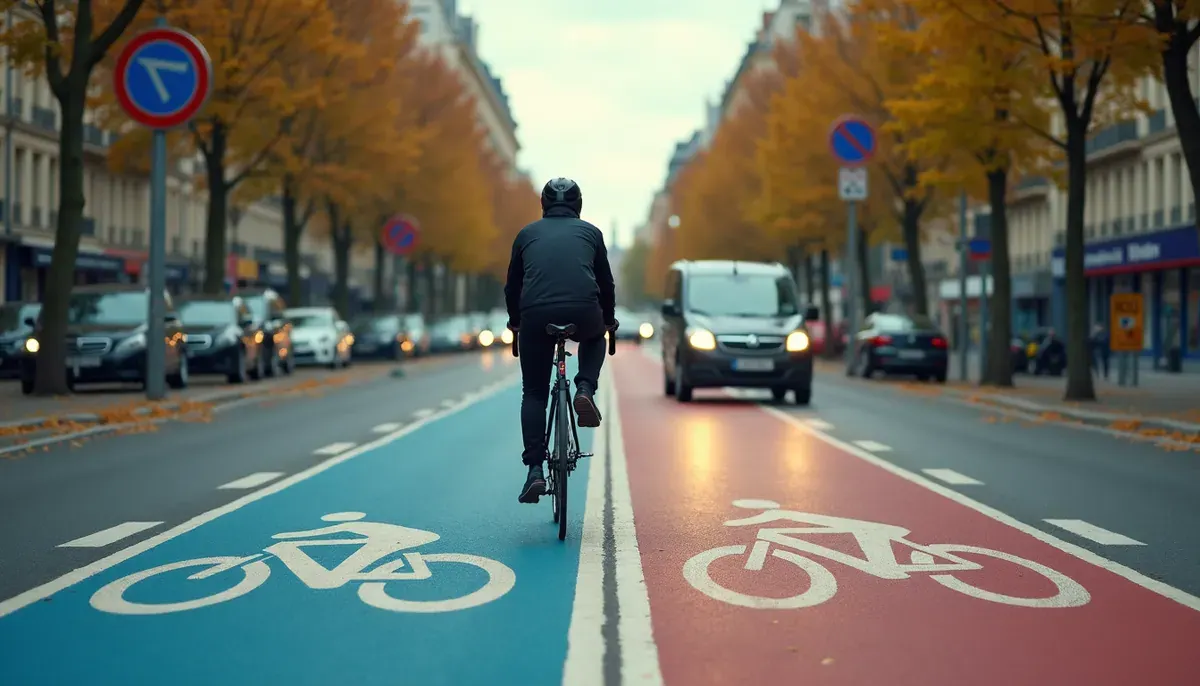
Paris has 1100 kilometres of cycle lanes in 2026, growing steadily since the 2024 Olympic Games legacy and the Paris City Bike Plan. This unique density in Europe transforms the driving test: mastering road sharing with cyclists becomes a core skill. Cycle-lane related faults rank in the top 3 of Parisian eliminatory errors. This article details the essentials: bike boxes, two-way cycle streets, blind-spot checks, priority crossings and common test-day mistakes.
The 2026 Paris cycle network
The Parisian cycle network includes three main types. Physically separated lanes (kerbs, dividers) on major axes like rue de Rivoli, boulevard Sébastopol and the quays. Painted cycle bands, simple dashed white lines, on most large avenues. Two-way cycle streets in one-way car streets, signed with M9v2 panels and ground markings. This diversity demands constant driver adaptation: the rule changes by lane type and signage.
Bike boxes at red lights
The bike box is the green-painted area or pictogram zone between the car stop line and the pedestrian crossing. Cyclists may move forward into it to start first when green. For drivers: NEVER stop in the bike box, on penalty of 135 euros flat (class 4) and a potential eliminatory fault at the test. Stop at least 5 metres before the light if the box is occupied. At the test, bike box compliance is systematically observed by the inspector.
Bike crossings and priorities
At intersections, cyclists on separated lanes often have automatic priority over vehicles turning right. Before any right turn, SYSTEMATICALLY check your right mirror AND blind spot with a quick glance over the right shoulder. In Paris, 70% of cyclist accidents at intersections come from blind-spot check failures according to Police Prefecture statistics. Inspectors view this check as fundamental: omission can mean a low safety competence score.
Two-way cycle streets
Two-way cycle streets, marked by signs and ground paint, let bikes ride against car traffic in one-way streets in 30 km/h zones. Concretely, a cyclist can appear ahead in a small street where you thought you were alone. Adopt moderate speed (30 km/h max in these streets) and anticipate a potential oncoming bike. At the test, inspectors often pick a route including a two-way cycle street to assess vigilance and adaptation.
Systematic blind-spot checks
Blind-spot checking is now a core Parisian test reflex. Three moments require it: before any overtaking (left mirror + left blind spot), before any lane change (interior + exterior mirror + blind spot), before opening a door (rear glance). The check is a clean head movement, about 45 degrees, enough to see the cyclist invisible in the mirror. Do not overdo (risk of losing line), but do not skip either. Instructors often film this gesture for video review.
Cyclist-related eliminatory faults
Several cyclist-related faults trigger immediate failure at the Paris test. Cutting off a cyclist in a right turn (sharing fault). Endangering a cyclist with a sub-1-metre overtake (law requires 1 metre in town, 1.5 metres outside per the Highway Code). Stopping in a bike box. Failing to yield to a cyclist on a priority lane. Opening a door without looking. All are sanctioned by an E (eliminatory) on the report. Golden rule: treat cyclists as priority and fragile users, never as a nuisance.
Next step
How to get the right support?
DevisPermis.fr connects you for free with a certified driving school near you. Answer 5 questions in 2 minutes, and an advisor will call you back within 48h* to offer a tailored package.
Discuss it for free*Excluding Sundays and public holidays