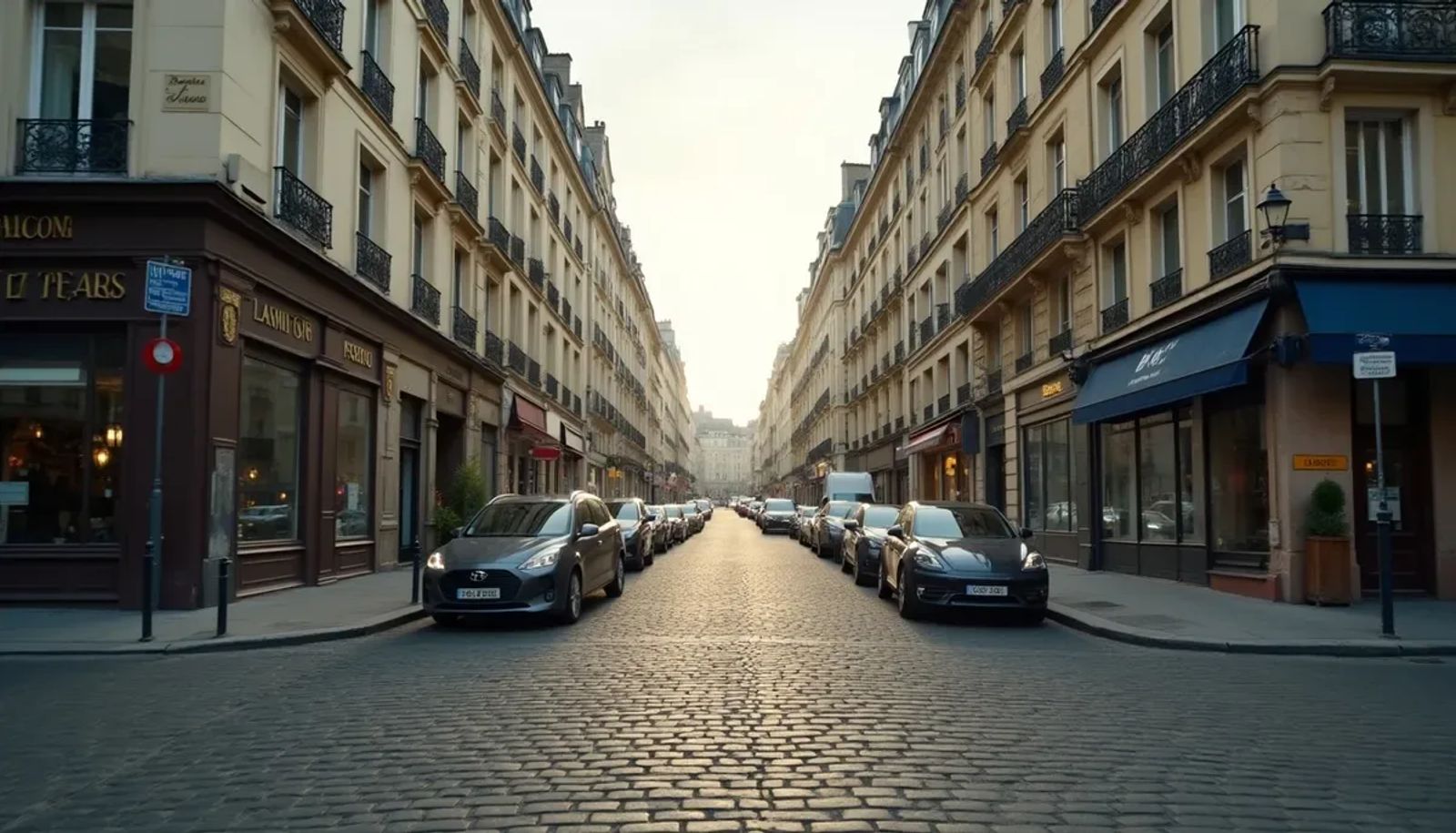
Right-of-way is the baseline rule of French road code: without signage, the vehicle coming from the right has priority. In Paris, it applies in most small streets of outer districts (10th, 11th, 18th, 19th, 20th) and the Marais (3rd, 4th). Yet it is a source of frequent mistakes at the B licence exam. This guide details its concrete 2026 Paris application.
Regulatory framework: article R415-5
Highway Code article R415-5 states: « Any driver approaching an intersection must give way to vehicles coming from the right, unless otherwise indicated. » The rule applies without signs (AB4 « Give way », AB5 « STOP », AB6 « Priority road », AB25 « Roundabout »). In Paris, over 60% of narrow-street intersections have no specific signage: right-of-way therefore applies by default.
Particularly affected districts
The Marais (3rd, 4th), Butte-aux-Cailles (13th), Montmartre (18th), Ménilmontant (20th), Belleville (11th, 19th, 20th) host hundreds of unsigned small intersections. A young driver who only learns on main axes (Rivoli, Haussmann, Voltaire) can be caught off guard if the examiner takes them through these streets.
Recognising a right-of-way intersection
Three clues: total absence of priority signs, broken (or missing) white lines on the road, equivalent width of the two crossing streets. If one of these three criteria is missing, check signage more carefully. An AB6 sign (priority road) above the windshield means you do NOT apply right-of-way: you are on a priority axis.
Specific case: end of priority zone
Some Paris avenues are « priority axes » until a break marked by an AB7 sign (end of priority road). Beyond, right-of-way resumes. Classic example: avenue d'Ivry (13th) is priority until the rue de Tolbiac crossing, where it reverts to standard. Examiners sometimes test this regime change.
Classic exam pitfalls
Five mistakes recur per Paris-Daumesnil and Paris-Maine examiners. 1) Not slowing near a default small intersection. 2) Crossing without checking right (even if street seems empty). 3) Sudden braking at seeing a vehicle right (danger for followers). 4) Confusing a priority road with an ordinary street. 5) Applying right-of-way on a one-way where it does not apply if flow comes from the left.
First technique: systematic scanning
Approaching any unsigned intersection: decelerate 50 m ahead, visual scan left-right-left, extended right scan if buildings reduce view. If a vehicle is visible right, yield. If invisible but possibly present, crawl forward until visibility. This technique is taught in all Paris schools but poorly executed by stressed candidates at the exam.
Exam and real-world sanctions
Right-of-way violation is a serious fault. If a vehicle is actually moving on the right and you force it to brake: eliminatory fault (E). If milder (slight slowdown, no danger): A fault (4-5 points). Outside exam, the offence is €135 and 4 licence points. Statistically, it is the 3rd cause of injury accidents in central Paris per ONISR.
Exception: dead-ends and cul-de-sacs
Dead-ends (C1 sign) are by definition non-priority: you must yield on exit. This case is simple but often forgotten. A cul-de-sac opening onto a normal street: you apply the right rule when exiting the cul-de-sac, even if you are right of the main flow.
Training on small Paris streets
If your school does not regularly practise small streets, ask explicitly. A 1.5-hour tour in Marais or Belleville streets, where right-of-way applies almost everywhere, will gain exam points. Experienced instructors include these zones in the final pre-exam lessons.
Request a free quote for training
DevisPermis.fr selects Paris schools that intensively practise right-of-way. Fill the form in 2 minutes, receive up to 3 quotes within 48h. No commitment.
Next step
How to get the right support?
DevisPermis.fr connects you for free with a certified driving school near you. Answer 5 questions in 2 minutes, and an advisor will call you back within 48h* to offer a tailored package.
Discuss it for free*Excluding Sundays and public holidays