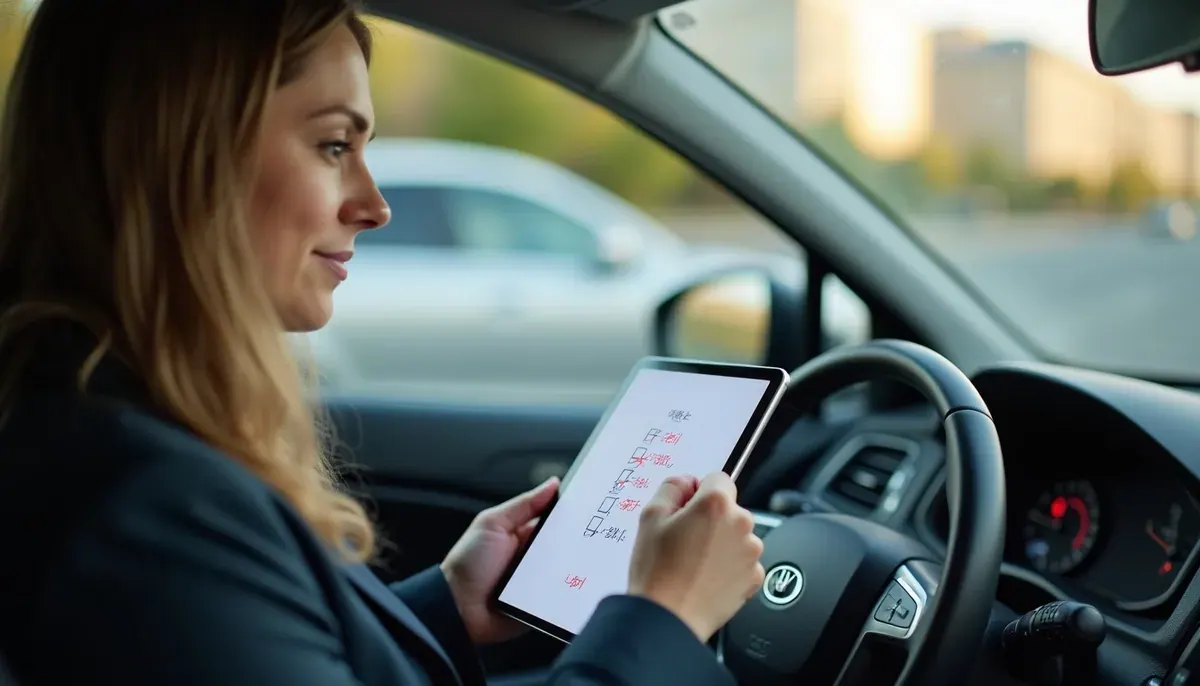
The Category B practical test in Paris remains the step most feared by candidates. After dozens of hours of driving and significant financial investment, the run with the examiner lasts 32 minutes and can flip on a single error. Knowing the scoring grid and eliminating faults precisely helps manage stress and avoid traps. In 2026, the official grid remains the one defined by the Interior Ministry through the road education offices. Here is everything to know to approach the test calmly.
The official assessment grid
The test rates 27 skills grouped in 5 major categories labeled A, B, C, D, E. Each skill yields 0, 1, 2 or 3 points based on mastery level. Maximum total is 31 points. To pass, you need at least 20 points and zero eliminating fault. Categories are: A knowledge and use of controls, B information gathering, C speed adaptation, D vehicle direction, E sharing the road with other users and autonomy.
Skills rated 3 points
Some key skills are worth 3 points because they are critical for safety: keeping safe distances, sharing the road with vulnerable users (cyclists, pedestrians, two-wheelers), merging properly on fast lanes, handling complex intersections. Mastering these points pushes the total over the threshold. In Paris, dense traffic makes these situations frequent: a candidate who manages a roundabout with bikes and buses starts with a clear edge.
The 7 absolute eliminating faults
A single eliminating fault means failure, whatever the score. The seven main ones are: refusal to yield (sign, red light, engaged pedestrian), crossing a solid line, exceeding the speed limit by more than 10 km/h without correction, loss of control (vehicle on pavement, scrape), dangerous driving endangering safety, refusal to obey the examiner, ignoring a stop signal (stop, red light). In Paris, red lights and pedestrians are the most frequent traps.
The amber light trap
Amber does not authorise passing if you can stop safely. Many candidates accelerate by reflex to avoid being honked at: this is an error. The examiner rates your ability to anticipate and stop without harsh braking. The right response: decelerate from flashing green, and stop calmly at amber if distance allows. Conversely, harsh braking at amber when 5 metres from the light is also penalised.
Tips from Paris examiners
Paris area examiners stress three points: information gathering (mirror checks, blind spot before any manoeuvre), fluidity (no prolonged hesitation at intersections), and strict speed limit observance. They appreciate a candidate who verbalises observations (for example, I slow because the light is about to turn red) because it shows situational awareness. Avoid overly ambitious manoeuvres: a modest but clean parallel park beats a random one.
Typical Paris and inner suburb routes
Paris area test centres (Bobigny, Versailles, Cergy, Massy, Nogent-sur-Marne) draw the route by lot. You will drive in the city with multiple lights, on heavy boulevards, sometimes on a fast lane section. One manoeuvre is required: parallel park, U-turn, angle parking, hill start. Total duration is 32 minutes including at least 25 minutes driving. You will also answer two interior/exterior vehicle check questions and one road safety question.
Managing test day stress
Arrive 15 minutes early, avoid excessive coffee, eat a light breakfast. During the test, breathe deeply at red lights, do not hesitate to ask the examiner to repeat. If you make a small error (stall, forget an indicator), do not panic: it is not eliminating, keep going. Most failures come from small fault accumulation rather than one major fault. Stay focused until the last second, the examiner also rates your arrival at the centre.
After the test: timelines and results
Results are no longer announced at the end of the test. You receive them within 48 hours via your digital space on the Road Safety website. In case of failure, you get a detailed skill assessment to target your work. Retake delay varies with regional pressure on slots, often 1 to 3 months in Paris. Passing gives you a provisional certificate valid 4 months while awaiting the final title.
Next step
How to get the right support?
DevisPermis.fr connects you for free with a certified driving school near you. Answer 5 questions in 2 minutes, and an advisor will call you back within 48h* to offer a tailored package.
Discuss it for free*Excluding Sundays and public holidays