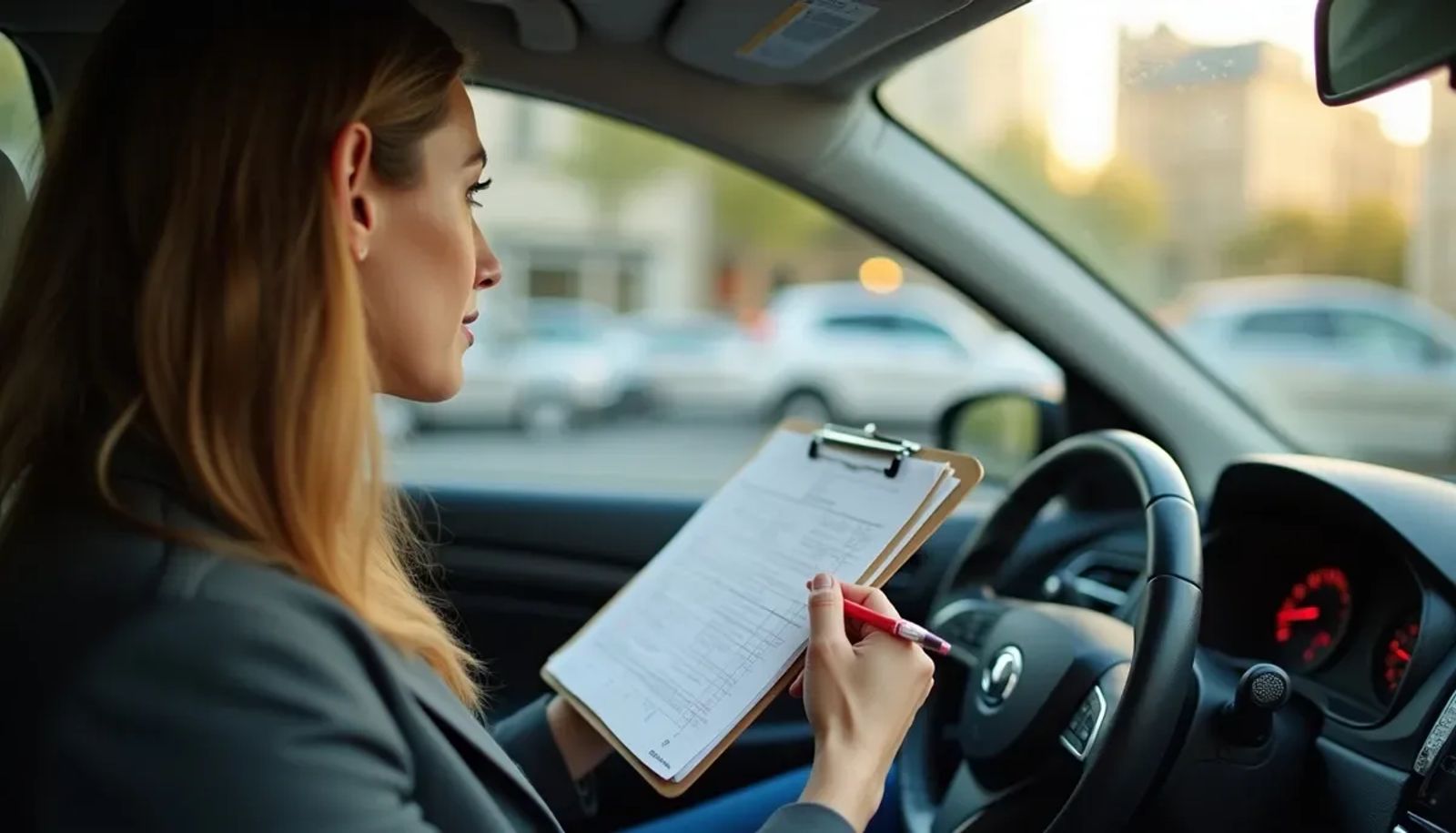
Passing the driving licence in Paris is acknowledged as more demanding than in rural areas. Annual Road Safety reports and examiner feedback published on the Ministry of the Interior website converge on ten mistakes that come back in almost every session. Spotting them before exam day avoids a costly failure - and secures your grade above the 20-point threshold required.
1. Forgetting the blind-spot check before setting off
Before any start, the candidate must check the three mirrors then turn their head to scan the left blind spot. In Paris, skipping this check when leaving a kerb-side parking space is cause number one of an eliminatory grade. Reminder: a cyclist passes every 12 seconds on average on the Rivoli axis according to the City of Paris counters.
2. Driving in a bus or taxi lane
Bus and taxi lanes are marked on the ground by a solid white line and a pictogram. Driving a few seconds in this lane is an eliminatory fault. In Paris, the lanes on boulevard de Sébastopol, rue de Rivoli and Champs-Élysées are most often mistakenly entered by stressed candidates. Outside the zone in Île-de-France, some are reserved for taxis day and night, others only at peak times.
3. Not respecting a bike box at a red light
The bike box is the space between the stop line and a second line 3 to 5 metres further, reserved for cyclists. Stopping in this box is a frequent mistake in Paris, particularly on restart. Examiners treat this fault as a technical fault worth 2 to 3 penalty points. Stop the front of the vehicle on the first white line.
4. Mishandling a hidden STOP sign
Paris has many STOP signs hidden by street furniture or bins. The candidate must: stop fully (wheels still), look left, right, left, then advance. Any « rolling » stop (speed > 0) at a STOP is eliminatory. Tip: aim for 1 to 2 seconds immobilisation, the only way to ensure a complete stop.
5. Confusing right-of-way and absolute priority
In the small streets of the 10th, 11th, 18th and 19th districts, right-of-way applies by default. Candidates from regions where priority is signposted everywhere tend to cross a junction without checking for a vehicle coming from the right. This mistake is rated as eliminatory if it creates danger, otherwise as a serious fault (5 points).
6. Running a late amber without braking
A light turning amber must be crossed following the braking rule: if the vehicle can stop safely, it must. In Paris, examiners systematically test this reflex on main boulevards. Running a late amber without trying to brake is an eliminatory fault. Better to stop at the last moment than force through.
7. Failing a parallel park in a dense area
Paris parallel parking is often done in spaces under 5.50 m long, between a parked car and a garage exit. Main mistakes: starting the manoeuvre without overtaking the front car enough, steering too early, forgetting the indicator. Three attempts are tolerated without major penalty. Beyond that, the grade drops.
8. Forgetting the indicator when changing lane on the ring road
On the Paris ring road (périphérique) and Île-de-France motorways, each lane change must be preceded by an indicator, mirror check (including blind spot) and smooth movement. Missing or late indicator is a serious fault. In Paris, examiners include a ring road stretch in 60% of exams starting from Daumesnil or Maine.
9. Not anticipating a stopped bus pulling out
When a RATP bus is stopped at a stop, it has priority to pull back into traffic. The candidate must ease off and let it go. Overtaking without vigilance is penalised. In 2026, with the new generation of Île-de-France Mobilités electric buses, which are quieter, visual anticipation is even more critical.
10. Driving too slowly or hesitantly
Paradoxically, driving at 30 km/h in a 50 zone is a mistake penalised by 2 to 4 points. Hyper-cautious candidates create traffic nuisance. Examiners reward smooth driving: drive at the allowed speed, anticipate lights, keep a 2-second gap from the vehicle ahead.
How to prepare specifically for these 10 traps
Ask your instructor to simulate each of these situations in your usual area. Two targeted 1.5-hour lessons are better than a week of general driving. On DevisPermis.fr, several partner schools offer a « Paris course » of 3 hours reviewing these ten mistakes and real exam routes. Request a free quote.
Next step
How to get the right support?
DevisPermis.fr connects you for free with a certified driving school near you. Answer 5 questions in 2 minutes, and an advisor will call you back within 48h* to offer a tailored package.
Discuss it for free*Excluding Sundays and public holidays