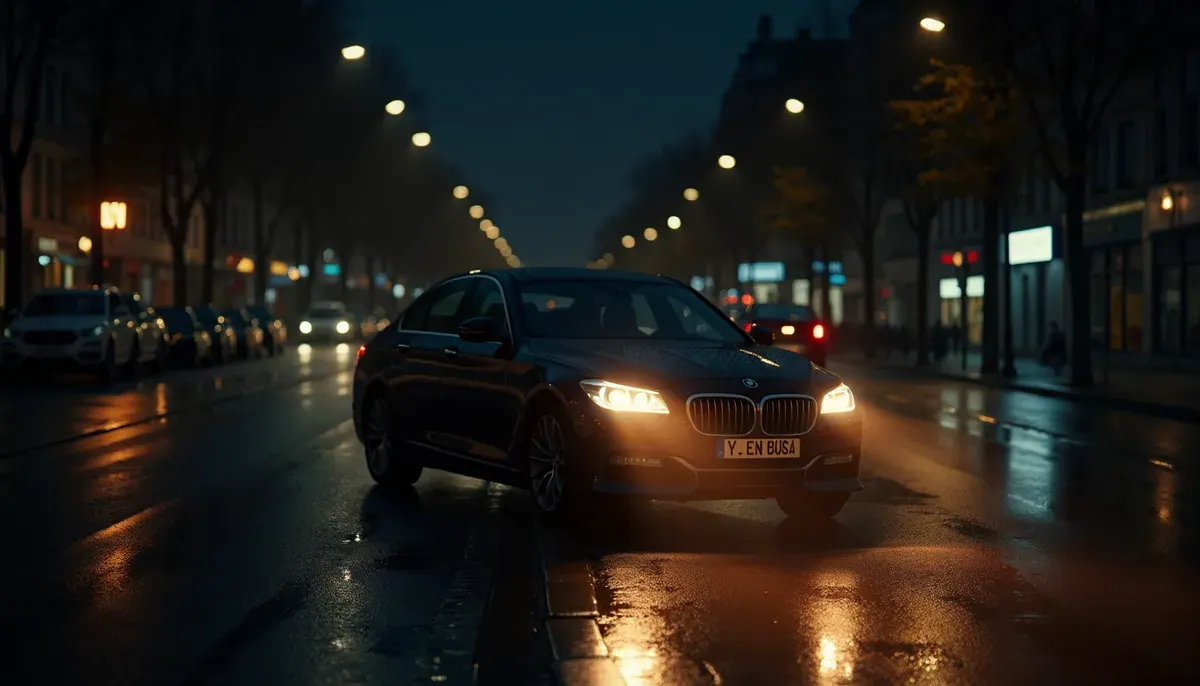
Driving at night in Paris in 2026 requires specific preparation. According to the 2025 ONISR, nearly half of fatal accidents happen at night, although this slot represents only 10% of traffic. Of 3,260 deaths in France in 2024, a significant share involves urban night driving. Paris adds its own pitfalls: uneven public lighting, scooters without lights, pedestrians coming out of bars into the road. This article offers a complete checklist: vehicle prep, headlight settings, glare management and the most sensitive Parisian zones between midnight and 5 am.
Pre-departure checklist
Before any night trip, systematically check the six light functions: low beams, high beams, position lights, indicators, brake lights and reverse lights. A dirty optic reduces the useful beam by up to 50%; clean optics with a suitable product. Also check inside and outside windows: condensation and fingerprints amplify light halos. A worn wiper blade becomes dangerous from the first night shower. Replace blades every 12 to 18 months according to Sécurité Routière.
Tyres and fuel level
Underinflated tyres add 4 to 7 metres of braking distance at 50 km/h. Check pressure every two weeks, especially in winter when it drops 0.1 bar per 10°C lost. Fill up before a long night trip: finding an open station at night in Paris has become harder in 2026 as historic stations gradually close. Download the TotalEnergies or Carbu app to spot 24/7 stations in the 17th, 19th and 20th arrondissements.
Headlight settings and high beams
Low beams light up to 30 metres ahead at the regulatory height. In Paris, high beams are strictly banned in lit urban areas, under penalty of a class-4 fine (90 euros flat). Use them only outside lit urban areas. The key rule: meeting a vehicle, overtaking a cyclist or following another vehicle within 150 metres requires switching back to low beams. Modern LED lights need dealer adjustment after any bumper impact.
Anti-glare
Facing a poorly adjusted vehicle blinding you, do not stare at the lights: look at the right edge of your lane to keep bearings. Cut speed by 10 to 20 km/h while regaining full vision (recovery takes 5 to 10 seconds). The day/night interior mirror should be switched to night mode to soften aggressive rear lights. In Paris, many recent SUVs have high headlights that blind oncoming drivers: stay calm, avoid retaliatory flashing that worsens danger for everyone.
Fatigue and vigilance
Fatigue is a factor in 20% of fatal night accidents according to ONISR. In Paris, prolonged ring road jams between 10 pm and 1 am add insidious mental fatigue. Take a 15-minute break every 2 hours, get out of the car, walk. Avoid even light alcohol (one glass = 0.2 g/L and already 12% of faculties impaired at night). Caffeine compensates temporarily but does not replace sleep. If your eyelids close, park safely and sleep 20 minutes.
Sensitive Parisian night zones
Some Parisian areas demand extra vigilance at night. The 18th (Pigalle, Barbès), 19th (Stalingrad, Place des Fêtes) and 20th (Belleville, Ménilmontant) concentrate late bar exits, jaywalkers and two-wheelers riding without lights. The ring road between Porte de la Chapelle and Porte de Bagnolet sees many phantom jams around 11 pm to 2 am. On the Champs-Élysées, anticipate club exits. Adopt a 3-second safety gap (instead of 2 by day) and drive systematically defensively.
Next step
How to get the right support?
DevisPermis.fr connects you for free with a certified driving school near you. Answer 5 questions in 2 minutes, and an advisor will call you back within 48h* to offer a tailored package.
Discuss it for free*Excluding Sundays and public holidays