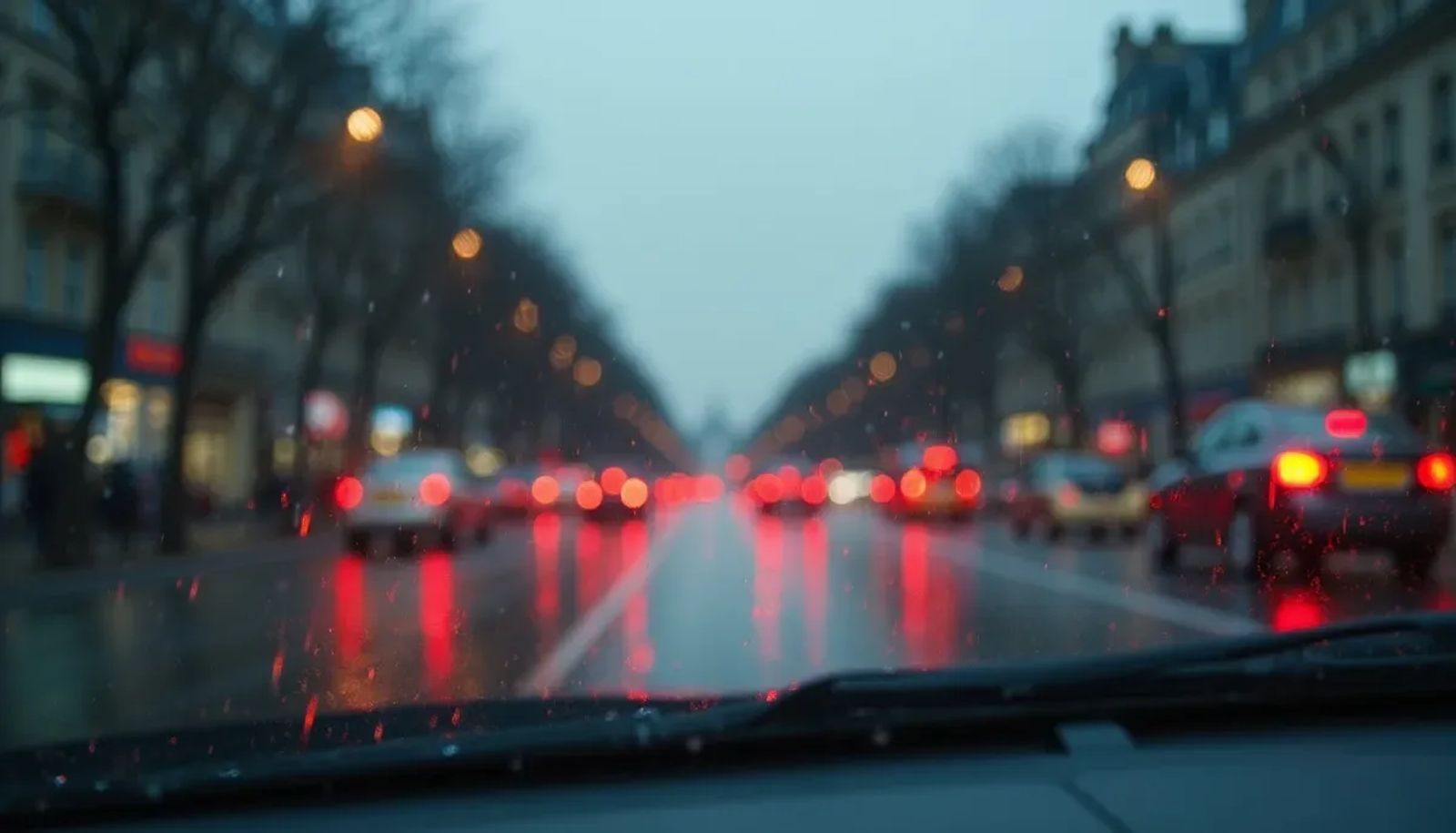
Paris gets 110 rainy days per year on average per Météo-France. Grip on wet cobblestones, puddles, autumn leaves, melted winter snow create tricky conditions, especially for young drivers. This guide recaps driving techniques in bad weather in central Paris in 2026, focusing on lighting, grip and driver aids.
Paris cobblestones: a wet trap
15% of Paris roads are still cobbled per the Road Directorate. Cobbles halve grip in wet conditions vs dry asphalt. Particularly affected areas: the Marais, Latin Quarter, Louvre surroundings, Montmartre. Sudden braking on wet cobbles can cause loss of control without ABS triggering (the vehicle slides forward). Adapt your speed.
Wet cobblestone braking technique
Three principles. First, raise safety distance to 4 seconds (vs 2 on dry asphalt). Second, brake early and progressively: sudden braking can lock wheels even with ABS. Third, avoid white stripes and manhole covers, the most slippery spots. At 50 km/h on wet cobbles, stopping distance can reach 45 metres, vs 28 on dry.
Fog lights and mandatory lighting
French 2026 rules are precise: dipped headlights are mandatory when visibility is reduced (rain, fog, dusk). Front fog lights are allowed in heavy rain, fog or snow - but must be turned off as soon as visibility returns (€35 fine otherwise). Rear fog lights are strictly for dense fog (<100 m visibility), never in plain rain.
Modern vehicle automation
Most 2022+ cars have automatic lights with rain/brightness sensor. Check « AUTO » mode is enabled. Note: some sensors miss fine rain - switch to manual if needed. Automatic wipers sometimes have a 2-3 second lag, insufficient in sudden downpour.
Aquaplaning: a frequent Paris phenomenon
Aquaplaning happens when a water film gets between tyre and road. In Paris, risk zones are steep axes with limited drainage: quai de la Mégisserie, Champs-Élysées, boulevard Saint-Germain. In aquaplaning: do not brake, do not turn the wheel, release the accelerator, let the car decelerate progressively. Grip usually returns in 2-3 seconds.
Prevention: checking tyres
A new tyre has 8 mm tread, the legal minimum is 1.6 mm. Below 3 mm, aquaplaning resistance is compromised. Check pressure monthly and the eve of long trips (recommended pressure on the driver door). A tyre under-inflated by 0.5 bar adds 5 metres braking distance at 90 km/h.
Snow and black ice in Paris
Paris averages 8 snow days per year. Municipal services salt main axes but not always small streets. With iced snow: drive at 30 km/h max, avoid sudden braking, use engine braking (downshift rather than brake), keep 5-6 seconds gap. If still snowing, avoid driving unless necessary.
Mandatory mountain equipment
Since November 2021, Mountain Law II requires winter tyres, chains or socks from 1 November to 31 March in 34 mountain departments. Île-de-France is not directly affected, but if you head to the Alps or Auvergne, prepare equipment. Textile chains accepted since 2023, easier to fit.
Driving during Météo-France orange alerts
In orange rain or storm alert on Paris, limit trips. Sudden quay flooding, fallen trees, overflowing drains are frequent. Check meteofrance.com and/or the Vigicrues Alertes Météo app. Avoidable trips should be postponed.
Learning to drive in the rain in Paris
Ask your instructor for at least two lessons in rain if scheduling allows. These lessons are often postponed by candidates, a mistake: the exam can fall on a rainy day. Practise: progressive braking, lighting, puddle handling. One or two targeted hours suffice.
Request a free quote including bad-weather lessons
DevisPermis.fr selects Paris schools that systematically train in bad weather. Fill the form in 2 minutes, receive up to 3 quotes within 48h. No commitment.
Next step
How to get the right support?
DevisPermis.fr connects you for free with a certified driving school near you. Answer 5 questions in 2 minutes, and an advisor will call you back within 48h* to offer a tailored package.
Discuss it for free*Excluding Sundays and public holidays