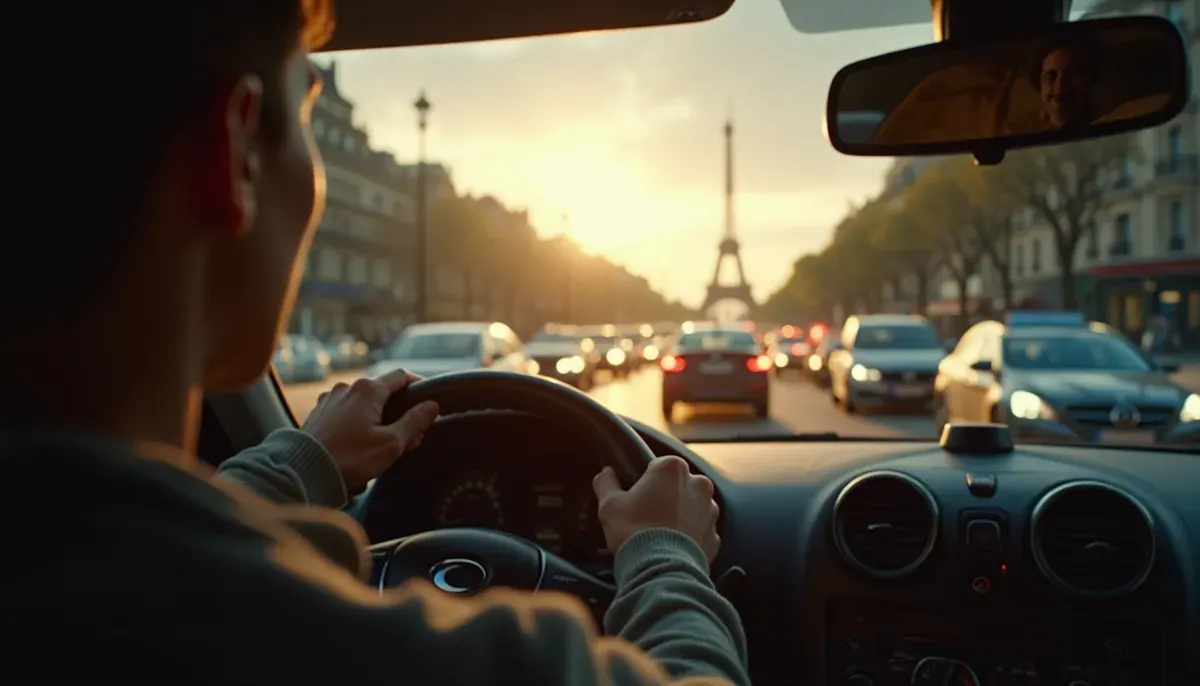
Driving in Paris just after passing your test often feels like an obstacle course. Between saturated ring road traffic during rush hour, narrow city center streets, and motorbikes weaving everywhere, pressure mounts fast for a young driver. In 2026, with traffic still dense despite low emission zones, managing stress in jams has become an essential skill. This article offers concrete techniques, validated by driving instructors and road psychologists, to turn these tough moments into mastered routine.
Why stress builds quickly in traffic jams
A jam triggers a physiological stress response: heart rate climbs, hands tense, vision narrows onto the bumper ahead. For a young driver whose reflexes are not yet automatic, this mental load adds to the effort of watching mirrors, signs and two-wheelers. According to ONISR 2025, drivers aged 18-24 account for a significant share of urban accidents, often through loss of concentration or abrupt action. Understanding what happens in the body is already a step toward easing the pressure.
Warning signs to recognise
Sweaty palms on the wheel, clenched jaw, frequent sighs, the urge to honk for no reason: these signs show stress is taking over. At this stage, the risk is tailgating the car ahead, accelerating sharply at the slightest gap, or changing lane without checking. Catching these signs early lets you act before the mistake. A simple rule: if you grip the wheel so tightly your knuckles whiten, you are in emotional overdrive. You need to come down.
Breathing techniques to stay calm
Box breathing is the fastest tool. Breathe in for 4 seconds, hold for 4, breathe out for 4, hold for 4. Repeat 3 to 5 cycles. Used by pilots and military, this technique lowers heart rate in under a minute. Practise it stopped at a red light or in a stationary jam. Another method: exhale longer than you inhale (4 seconds in, 6 seconds out), which activates the parasympathetic system and calms the body.
Anticipate rather than react
A good driver does not react, they anticipate. In a jam, keep a safety distance of at least half a car length. This avoids emergency braking and reduces eye fatigue. Look far ahead, not just at the bumper: spotting brake lights three cars ahead lets you ease off the throttle gradually. Listen to traffic radio or use a GPS app that flags slowdowns in real time. Anticipating also means accepting you cannot speed up the jam.
Common young driver mistakes
Tailgating to stop a motorbike from filtering: wrong, dangerous, and punishable. Honking out of frustration: useless, and may trigger a confrontation. Constantly changing lane to gain two metres: this raises accident risk with no real time gain. Switching on hazards for no reason: they are for signaling danger, not your annoyance. These actions reveal poor emotional control more than a driving problem.
Alternative routes and planning
Paris offers several alternatives to the saturated ring road: the Marechaux boulevards, the Seine quays, or a detour by RER for longer trips. In 2026, GPS apps integrate low emission zones and propose routes matching your Crit Air sticker. Before a trip, check rush hours: between 8am and 10am, and 5pm and 8pm, it is better to shift or allow 30 minutes margin. Saturday evening and Sunday late afternoon are also heavy. Planning cuts the surprise factor and therefore stress.
Managing fatigue and heat waves
A jam in 35 degree heat in Paris in July is exhaustion guaranteed. Keep water in the car, set air conditioning without overcooling to avoid thermal shock when stepping out, and take a break every two hours on long trips. Fatigue degrades hazard perception as much as alcohol, according to the Road Safety authority. If your eyelids feel heavy, exit at the next service station. In winter, overly strong heating also makes you drowsy: ventilate regularly.
Experience and regular practice
The more you drive in jams, the more your brain automates the situation. The first six months after passing the test are the most exposed to urban accidents. A tip: start with short trips off-peak, then ramp up gradually. If possible, do a jam trip with an experienced driver beside you, who can voice their anticipations. City driving is a skill you build, not a gift. By applying these techniques, you will turn Paris jams into plain routine.
Next step
How to get the right support?
DevisPermis.fr connects you for free with a certified driving school near you. Answer 5 questions in 2 minutes, and an advisor will call you back within 48h* to offer a tailored package.
Discuss it for free*Excluding Sundays and public holidays