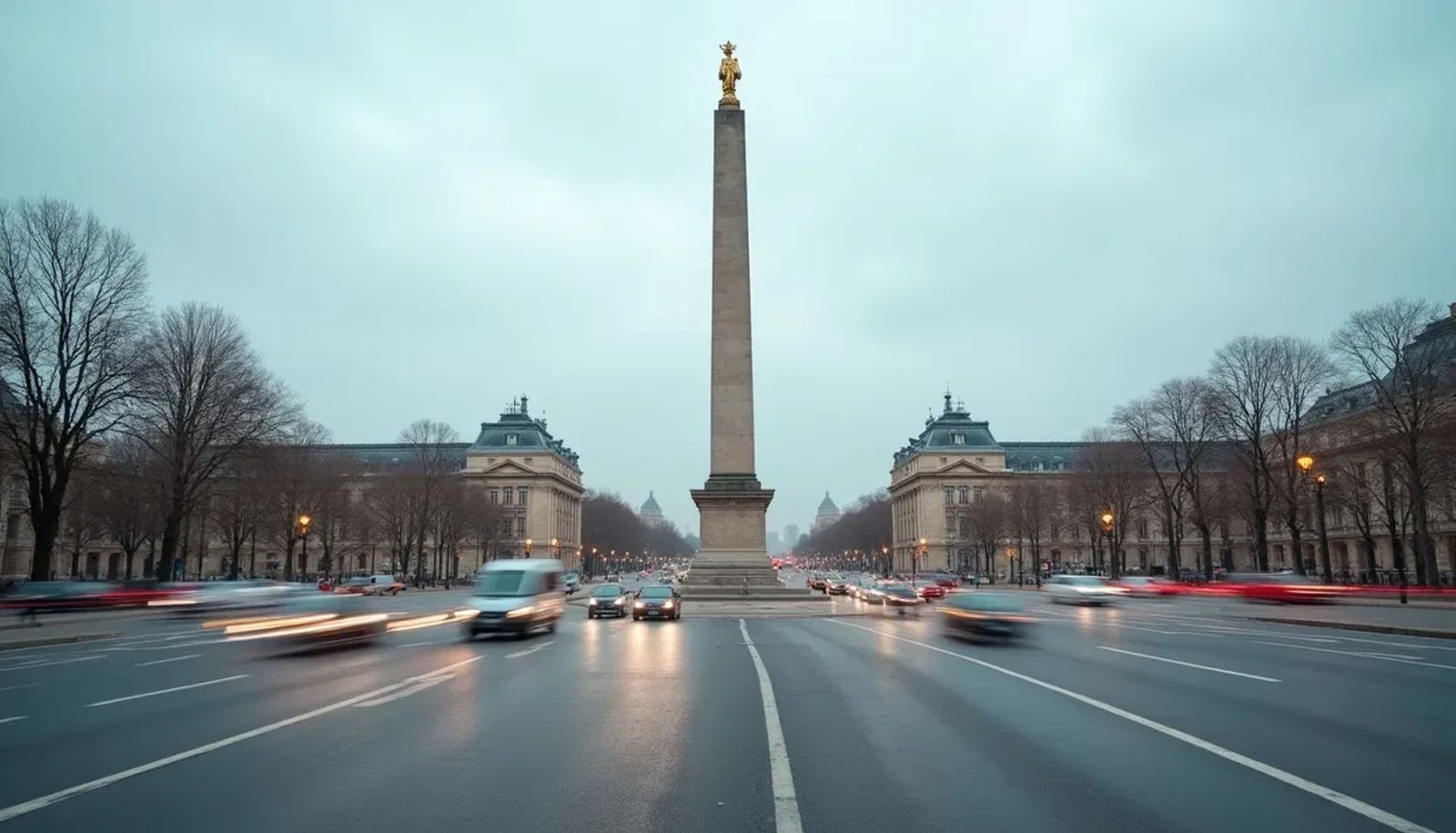
Place de la Concorde is the largest square in Paris (8.64 hectares). Its complexity lies not only in size but in the number of accesses: 12 entries and exits, continuous flow of buses, taxis, bikes and pedestrians, and a circulation logic that confuses even seasoned drivers. For a B licence candidate, Concorde is regularly cited among Paris's 3 hardest zones by Paris-Maine centre examiners. This guide decodes how it works.
2026 layout of the square
Concorde is not a true roundabout: it is a « light-regulated roundabout square ». Concretely, you go around the obelisk but all intermediate junctions are regulated by traffic lights. Lanes are 3-wide. Since progressive pedestrianisation of upper Champs-Élysées and the 2024 redesign, the square's overall flow dropped 15% per the Police Prefecture, but complexity remains.
The 12 accesses to know
Going clockwise from the north: rue Royale (north), rue Boissy-d'Anglas, avenue Gabriel, Champs-Élysées (west), cours Albert-Ier, pont de la Concorde (south), quai des Tuileries, rue Saint-Florentin (east), rue de Rivoli, rue Mondovi, avenue de Marigny, avenue du Général Lemonnier. The difference with a classic roundabout is you are not on a continuous ring: you move segment by segment through lights.
Right-of-way at Concorde
Single rule: traffic lights command everything. Green authorises you to proceed in your lane. Red stops you on the stop line. There is no classic « roundabout priority »: each light opens a new phase. Pedestrians have dedicated phases, often in potential conflict with vehicles turning right. Examiners closely watch pedestrian management.
Entry from the Champs-Élysées
This is the most-tested approach at the exam. You arrive from Champs-Élysées on 4 lanes. Anticipate your direction 200 m ahead: straight for the bridge, left for rue de Rivoli, right for quai des Tuileries. Getting the wrong lane 100 m from the square forces a sudden manoeuvre - serious fault (4 points).
Classic exam pitfalls
Five mistakes recur per Paris-Maine examiner feedback. 1) Changing lane inside the square (forbidden to cross 2 lanes on a roundabout, eliminatory). 2) Running a late amber out of fear of « missing the exit » (danger). 3) Forgetting the indicator before each direction change in the square. 4) Missing a pedestrian crossing at the rue Royale corner (high footfall). 5) Driving at 30 km/h out of caution when 50 is allowed on main lanes.
Managing buses and taxis
Rue de Rivoli and rue Royale have bus-taxi lanes marked on the ground. Driving in them is an eliminatory fault. Approaching Concorde, position on the 2nd lane from the right to avoid any confusion. Cruising taxis change lane abruptly, anticipate their moves.
Technique: the 3 golden rules at Concorde
First, anticipate your exit 200 m ahead: if your instructor states the destination, move immediately into the right lane. Second, drive at the allowed speed (50 km/h on main lanes, 30 km/h in peripheral zones): do not slow down unnecessarily. Third, keep a 2-second gap to the vehicle ahead to anticipate a sudden brake at the light.
Systematic checks
Before each lane change: interior mirror, side mirror, blind spot, indicator, manoeuvre. This routine matters especially at Concorde due to dense two-wheeler flow. At 50 km/h, stopping distance is 28 metres: keep a margin.
Practising before the exam
1st, 7th and 8th district schools systematically practise Concorde. Ask for at least 2 hours in the square: one mid-day (normal traffic) and one at 6.30 pm peak (extreme). Practise the 4 most exam-used entries: Rivoli, Champs-Élysées, pont de la Concorde, avenue Gabriel.
Request a free quote for Concorde training
DevisPermis.fr selects Paris schools mastering Concorde perfectly. Fill the form in 2 minutes, receive up to 3 quotes within 48h with hours dedicated to Paris black spots. Free, no commitment.
Next step
How to get the right support?
DevisPermis.fr connects you for free with a certified driving school near you. Answer 5 questions in 2 minutes, and an advisor will call you back within 48h* to offer a tailored package.
Discuss it for free*Excluding Sundays and public holidays